These includes friction wheels, belt and pulley sysytem, gears, chain and sprockert system, and worm gears.
FRICTION WHEELS
Are a set of two wheels located one next to other. Motion is transmitted betwwen the wheels by the friction between them.
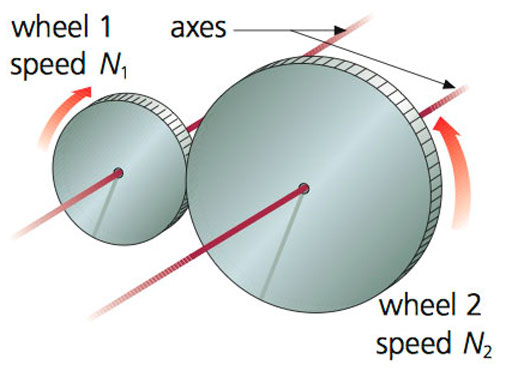
The transmission ratio is the ratio between the size of the friction wheels and the speed of rotation:
i=w1/w2=d2/d1
where w1 and w2 are the speeds of rotation of wheels 1 and 2 and d1 and d2 are their diameters, respectly.
Characteristics and applications
The driven wheel always rotates in the opposite direction to the driver wheel.
Friction wheels can slip, so they aren’t used to transmit large amounts of power.
Friction wheels can be to subject to wear and tear when they are used over long periods, because the transmission is obtained by friction.
BELT AND PULLEY SYSTEM
This system is made up of two pulley wheels joined by a belt that slots into the grooved rim of the wheels.
When one of the wheels is rotated, the belt transmit the motion and makes the other wheel rotate.
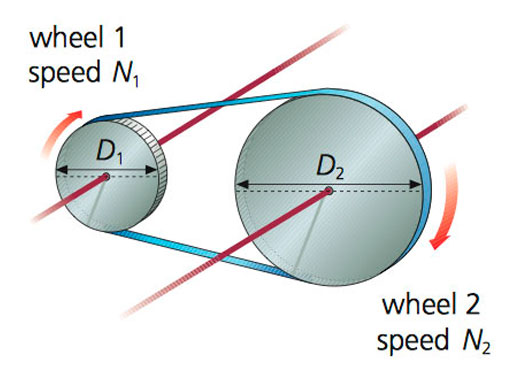
Like with friction wheels, the method of calculating transmission ratio in this mechanism is :
CHARACTERISTICS AND APPLICATIONS
Belt and pulley systems transmit rotatory motions between shafts located at difference points.
Their opperation is silent.
GEARS
A gear is a mechanism consisting of two wheels with teeths.
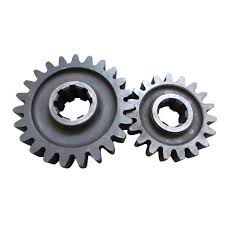
Just like friction wheels the two wheels rotate in opposite directions. If we want the input wheel to rotate in the same direction as the output wheel, we insert an idler between the two, which doesn’t modify the output speed.
CHARACTERISTICS AND APPLICATIONS
Gears can be used for large power transmission because the teeth on the wheels mesh together, so the never slip.
There is a lot of friction between the teeth, so it is necessary to grease between the wheels.
They are noisy.
In toothed wheels, the transmission ratio is calculate according to the number of teeth on each wheel using these formula:
i=w1/w2=z2/z1
Where w1 and w2 are the speeds of wheels 1 and 2, and z1 and z2 are number of teeth on each wheel.
CHAIN AND SPROCKET SYSTEMS
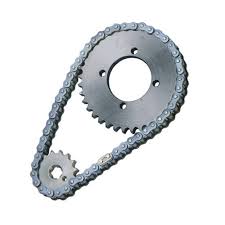
These systems consist of two toothed wheels separated by a distance and connected by a chain that meshes with the teeth of two wheels.
CHARACTERISTICS AND APPLICATIONS
They don’t slip because the teeth on the wheels mesh with thw chain, so these systems can be used for large power transmissions.
They need greasing to prevent jamming.
They are noisy mechanisms.
WORM GEAR
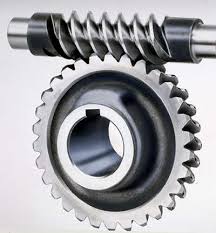
This rotary trasmission mechanism consists of a worm that is fitted to the driver shaft and a toothed wheel that is fitted to the driven shaft.
The worm only have one tooth, the transmission ratio of this mechanism is described as:
i=z1/z2=1/z2
Where z2 is the number of teeth of the worm wheel.
CHARACTERISTICS AND APPLICATIONS
It is an excellent speed reducer.
It is compact and quiet.
The motion isn’t reversible; This means that the worm must move the wheel and not the other way around because this would cause the mechanism to jam.This act an excellent safety feature.

 Tecnology Ale and Cris