MOTION CONVERSION MECHANISM

Some mechanism covert motion as well as transmitting it.

SCREW AND NUT

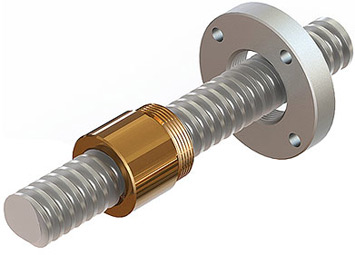
This mechanism consist of a screw and a nut.The rotatory motion of the nut is converted to a forward linear motion in the screw.
CHARACTERISTICS AND APPLICATIONS

It is a good speed reducer.The screw rotates quikly but the linear motion of the nut is slower.

It is reversible.We can rotate the nut to create linear motions in the screw or rotate the screw to create linear motion in the nut.

RACK AND PINION

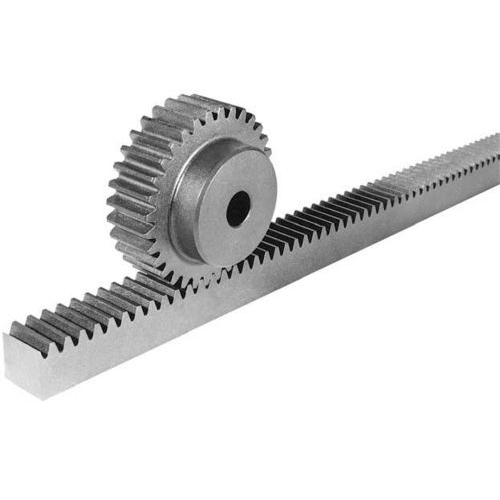
This mechanism consist of a toothed wheel that meshes with a toothed bar.The rotatory motions of the pinion is converted to a linear motion in the rack.
CHARACTERISTICS AND APPLICATIONS

This mechanism is very smooth and precise.

It is reversible.

CRANK AND SLIDER

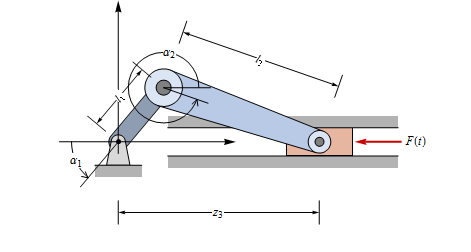
This mechanism consist of a rigid bar that is connected at one end to a crank.

The rotary motions of the crank is converted to reciprocating linear motion in connecting rod.
CHARACTERISTICS AND APPLICATIONS

It is reversible

CAMS

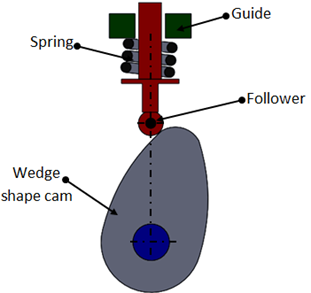
Cams are usually elliptical in shape. They are attched to a shaft and, as they rotate, they drive an element called the follower. A spring keeps the follower in permanent contact with the cam.

When the projecting part of the cam hits the follower, the rotary motion of the cam is transmitted by the follower as reciprocating linear motion.
CHARACTERISTICS AND APPLICATIONS

Cams convert rotary motion into linear reciprocating motion.

ECCENTRIC CAM

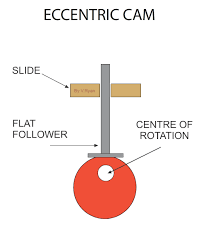
An eccentric is a mechanism similar to a regular acm. It is of a wheel where the axis of rotation isn’t the geometrical centre. It convert rotary motion into linear reciprocating motion and is used in older sewing machines.
ROTATING TRANSMISSION MECHANISM

These includes friction wheels, belt and pulley sysytem, gears, chain and sprockert system, and worm gears.

FRICTION WHEELS

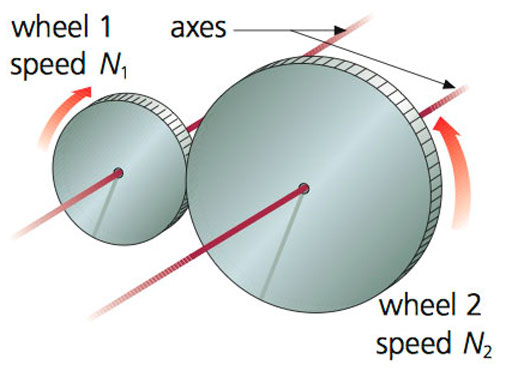
Are a set of two wheels located one next to other. Motion is transmitted betwwen the wheels by the friction between them.

The transmission ratio is the ratio between the size of the friction wheels and the speed of rotation:

i=w1/w2=d2/d1

where w1 and w2 are the speeds of rotation of wheels 1 and 2 and d1 and d2 are their diameters, respectly.

Characteristics and applications

The driven wheel always rotates in the opposite direction to the driver wheel.

Friction wheels can slip, so they aren’t used to transmit large amounts of power.

Friction wheels can be to subject to wear and tear when they are used over long periods, because the transmission is obtained by friction.

BELT AND PULLEY SYSTEM

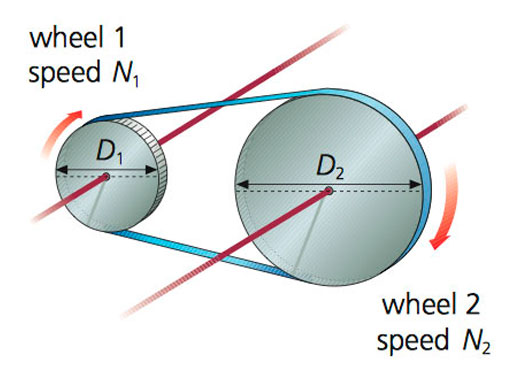
This system is made up of two pulley wheels joined by a belt that slots into the grooved rim of the wheels.

When one of the wheels is rotated, the belt transmit the motion and makes the other wheel rotate.

Like with friction wheels, the method of calculating transmission ratio in this mechanism is :

CHARACTERISTICS AND APPLICATIONS

Belt and pulley systems transmit rotatory motions between shafts located at difference points.

Their opperation is silent.

GEARS

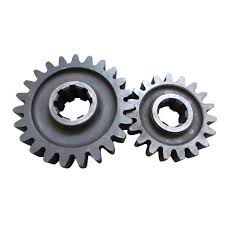
A gear is a mechanism consisting of two wheels with teeths.

Just like friction wheels the two wheels rotate in opposite directions. If we want the input wheel to rotate in the same direction as the output wheel, we insert an idler between the two, which doesn’t modify the output speed.

CHARACTERISTICS AND APPLICATIONS

Gears can be used for large power transmission because the teeth on the wheels mesh together, so the never slip.

There is a lot of friction between the teeth, so it is necessary to grease between the wheels.

They are noisy.

In toothed wheels, the transmission ratio is calculate according to the number of teeth on each wheel using these formula:

i=w1/w2=z2/z1

Where w1 and w2 are the speeds of wheels 1 and 2, and z1 and z2 are number of teeth on each wheel.

CHAIN AND SPROCKET SYSTEMS

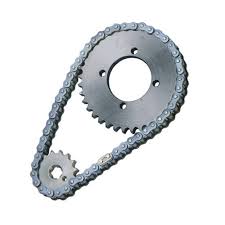
These systems consist of two toothed wheels separated by a distance and connected by a chain that meshes with the teeth of two wheels.

CHARACTERISTICS AND APPLICATIONS

They don’t slip because the teeth on the wheels mesh with thw chain, so these systems can be used for large power transmissions.

They need greasing to prevent jamming.

They are noisy mechanisms.

WORM GEAR

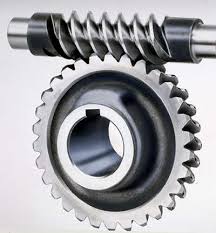
This rotary trasmission mechanism consists of a worm that is fitted to the driver shaft and a toothed wheel that is fitted to the driven shaft.

The worm only have one tooth, the transmission ratio of this mechanism is described as:

i=z1/z2=1/z2

Where z2 is the number of teeth of the worm wheel.

CHARACTERISTICS AND APPLICATIONS

It is an excellent speed reducer.

It is compact and quiet.

The motion isn’t reversible; This means that the worm must move the wheel and not the other way around because this would cause the mechanism to jam.This act an excellent safety feature.

Linear transmission mechanism

These are a type of simple machine.

LEVERS

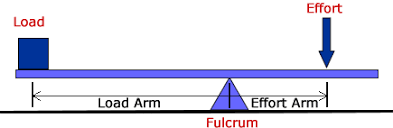
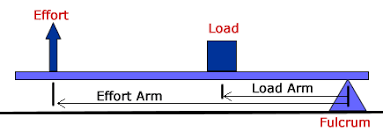
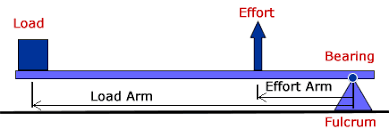
A lever is a rigid bar tha can pivot ona point of support called fulcrum. It is used to lift load by applying force to a point on the bar. We call the applied force effort, whereas the load to be lifted or the resistance that must be overcome is known as the resistance.

The law of the lever, which describes the force of a lever in equilibrium, states that:

The result of the applied efford multiplied by the distance from the fulcrum must be equal to the result of the resistance to overcome multiplied by the resistance from the fulcrum.

CLASS 1 LEVERS

The fulcrum is located between the weight or resistance to overcome and the point where the force is applied.


CLASS 2 LEVERS

the fulcrum is at one end of the lever and the efford is at the other end. The resistance to overcome is located between the fulcrum and the effort

CLASS 3 LEVERS

The effort is located between the fulcrum and the resistance.

PULLEYS

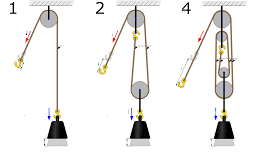
Pulleys are used to lift heavy loads. They are wheels witha grooved rim.

FIXED PULLEYS

The axis of rotation of the pulley is fixes by attaching it to a support that prevents it from moving.

With fixed pulleys, we still have to put in the same effort to lift the weight, but they make the task easier by changing the dirction of the effort: when we lift weight without a pulley, we have lift them up, whereas when we use a pulley, we make a downwards effort, which is easier.

MOVEABLE PULLEYS

Moveable move vertically as well as turning when we pull on the rope. These pulleys reduce the efort required to lift a load by half.

Systems made up of moveable and fixed pulleys are called hoists. The force needed to lift a loadin a hoist is reduced in proportion to the number of moveable pulleys in the system.